Camping guides
10 winter camping tips: from the people who do it best
)
The ten rules our owners and most seasoned hirers have landed on over thousands of winter trips across the country
Most Australians treat winter as the off-season. But the most experienced campers? They're quietly book up the winter sites - and leaving summer to everyone else.
Empty campsites. Real-deal prices. Crisp air, clearer skies, and country the rest of the year barely shows you. Winter rewards the curious:
Fewer crowds. The most popular campsites you couldn't book in January are mid-week available in July.
Real savings. Owners drop their nightly rates 15–25% across June–August. National park fees often drop too.
Clearer skies. Less haze, less humidity. The darkest skies of the year — best stargazing window of the calendar.
Better wildlife. Humpbacks tracking up both coasts. Wombats and wallabies active in the cooler hours. Whale sharks at Ningaloo.
The best sunsets of the year. Clear winter air turns every dusk into something cinematic — the kind of evening you'd pay a lot to see from a hotel window.
But winter rewards preparation. Get a few of the basics right and you'll be the one with the cosy setup, the stars, and the fire. Get them wrong and you'll be the one packing up wet at 11pm wondering why you came.
Here are the ten rules our owners and most seasoned hirers have landed on over thousands of winter trips across the country.
TL;DR — The 10 winter camping rules
Plan around the light — sunsets are spectacular, but they arrive early
Drive defensively after dark — wildlife move at first and last light. Or stick to short trips and skip the rural roads
Mind the black ice in alpine country — and if you're in 2WD, base in Jindabyne and take the Skitube up
Pack for the postcode, not the season — Tassie isn't Cairns
Set up before the weather closes in — then enjoy the cosiest afternoon you'll have all year
Book mid-week for the deepest savings — winter pricing rewards flexibility
Get the fire going — properly. The best part of any winter trip.
Hire a winter-ready rig if you're heading south or alpine. Standard's fine up north.
Use your owner's local knowledge — it's the best free advice you'll get
Embrace slow camping — three-night minimums, less driving, more savouring
1. Plan around the light — and don't miss the best part of the day
)
Winter sunsets are on another level.
The dry, clear air that comes with the season turns every dusk into something cinematic — pink skies, gold light on the rig, the kind of evening you'd pay a lot to see from a hotel window.
The catch: in June and July, the sun's gone by 5pm across most of southern Australia. You won't have the 14 hours of light you get in summer — and the best part of the day arrives early.
The rule our owners repeat: plan every leg to land you at camp by 4pm. In an RV, that's plenty. Park-and-play setups take all of five minutes — level the rig, pop the awning, you're done. That gives you a clear hour of golden light to get the fire going and pour the first drink while the sun does its thing.
Factor the shorter daylight into your trip planning. Build legs around 200–300km rather than 500km. Treat the sunset as the headline event of the day, not the moment you wished you'd left earlier.
2. Drive defensively on country roads after dark — or skip them altogether
)
If your trip takes you out to remote campsites or alpine country, night driving in the bush is a different sport to anything you do at home. And winter makes it harder.
Wildlife. Drive the Monaro Highway into Jindabyne at last light and you'll lose count of the kangaroos on the verge. Wombats and pademelons in Tassie. Wallabies everywhere from coastal NSW to the High Country. Winter animals move at first and last light, and they're not road-smart.
Cold engines, cold tyres, dark roads. Sub-zero overnight temps mean your rig isn't at its sharpest for the first twenty minutes of a morning drive. Country roads without streetlights are unforgiving. A kangaroo strike at 80km/h can damage a rig badly enough to end the trip.
Arrive before dark. If you can't, slow down hard.
The escape hatch. Country driving not your thing? Don't have the time, energy, or the comfort zone for long rural legs? Winter is also peak season for short road trips — a couple of hours out of any capital city and you're parked up somewhere brilliant. Check out our complete itinerary list to short road trips you can do from every major city without rural night driving — country towns close enough that off-light arrivals aren't a worry.
You don't have to go bush to get the winter camping experience. Some of the best winter trips happen 90 minutes from your front door.
3. Mind the black ice — and know your 2WD vs 4WD options
)
If your trip climbs above the snow line — Bright, Jindabyne, Thredbo, the Victorian alps — overnight temperatures drop below zero and shaded sections of road can stay iced past sunrise. Sometimes well past sunrise.
The rig you're in changes the rules.
In a 4WD with proper tyres — and Camplify has plenty of off-road campers and rooftop-tent rigs on the platform — you've got real flexibility above the snow line. NSW and VIC alpine regulations exempt most 4WDs from the chain rule during chain-declared periods, provided you have adequate tread depth. That opens up remote alpine campgrounds that 2WD travellers can't reach: Geehi, Khancoban, Dargo, and the back-roads of Mount Hotham.
In a 2WD campervan or motorhome, the rules tighten fast. NSW and Victoria both legally require snow chains for 2WD vehicles above the chain line during declared snow seasons (typically June to October). Most hire setups don't include chains as standard — confirm with your owner before you commit. Without them, you can be turned around at the chain checkpoint.
The 2WD travel hack most campers miss: you don't actually need to drive into the snow.
Park up in Jindabyne — there are hundreds of Camplify hosts in the Snowy region during winter, most under $200 a night
Take the Skitube from Bullocks Flat (off the Alpine Way) up to Perisher Valley and Blue Cow — runs the entire winter season, no chains required
Daily buses run from Jindabyne to Perisher and Thredbo throughout ski season
You get the snow day. Your rig stays warm, dry, and parked below the snow line. Cheaper than alpine accommodation, more flexible than a hotel, and you're back at the fire by dark.
Whatever you're in: drive alpine sections in full daylight only. Bridges freeze first. And check the owner's notes on snow chains before you leave.
View Winter-ready RVs on Camplify →
4. Pack for the postcode, not the season
)
"Winter" in Australia isn't one thing.
Ange's Bright hirers head out in thermals and beanies; the same week, hirers up north are in boardies. The rule every experienced camper lands on: ignore the season, pack for the postcode.
Tasmania. Four seasons in a day, every day. Layers, a jacket you can ditch, sunscreen (the Tassie sun is sharper than people expect). Cradle Mountain in particular is better in winter — fewer crowds, snow on the pandani, eerie and still.
The Snowies and Victorian High Country. Subzero nights, snow chains required above the line, frost on the windscreen by morning. One more layer than you think you'll need, plus gloves for setting up at camp.
The southern coasts — Margaret River, Albany, the Great Ocean Road. Milder, but wetter and windier than people assume. A proper waterproof, not a summer shell.
The north — Cairns, Darwin, the Kimberley. Winter is the season up there: dry, warm, bug-free. Pack like you're going in summer; just leave the stinger suit at home.
The Red Centre — Uluru, Coober Pedy. 25°C days, near-zero nights. The biggest day-to-night temperature swing in the country. Layers for the morning, shorts by midday, the warmest jacket you own by sundown.
Want destination-specific inspo? Our winter camping destinations guide → breaks down the best winter trips by region, with specific itineraries you can lift and book.
5. Set up before the weather closes in — and then enjoy it
)
Winter brings rain, and setting up an awning, levelling a rig, or pitching a tent in the dark and the wet is the fastest way to sour the whole trip.
Check the forecast for your arrival window — not just the trip generally. If rain's forecast for the afternoon, drive earlier. If it's a bluebird morning followed by an afternoon storm, plan your arrival around it.
Have your setup sequence sorted before you arrive. Know which order things come out, where the level pads go, how the awning catches the wind. Practice it in your driveway if it's your first time with the rig. Or just ask the owner at handover — every rig has its quirks and they'll save you twenty minutes of guesswork.
But here's the genuine upside. Once you're set up, foul weather in an RV is one of life's small joys. Heater cracking, kettle whistling, doors closed, awning down. Cards on the table, books open, kids quiet for once. Some Camplify rigs even include proper espresso setups in the inclusions — browse winter-ready RVs → if a flat white in the rain sounds good to you.
A rainy afternoon parked up in a warm RV is the cosiest you'll be all year. Tents make bad weather hostile. An RV turns it into atmosphere. The trick is just to be set up before it hits.
6. Book mid-week for the proper savings
)
If you've ever packed a small car for a camping trip, you know the problem...
The best-kept secret of winter pricing isn't the season itself — it's the days. Mid-week availability through June, July, and August is where the deepest savings live.
What our owners report:
Mid-week winter trips often run 30–40% cheaper than peak summer weekends
Minimum-night requirements drop or disappear off-peak — three-night trips become two-night trips with no penalty
National park sites that fill 90 days out in summer are walk-up bookable in winter
Caravan parks that won't budge on price in January are negotiable in July
If you've got the flexibility, leave on a Sunday and come back on a Wednesday. The country opens up, the prices come down, and most of the campsite is yours.
7. Get the fire going — properly
)
There's no winter camping tip more universally agreed on than this one...
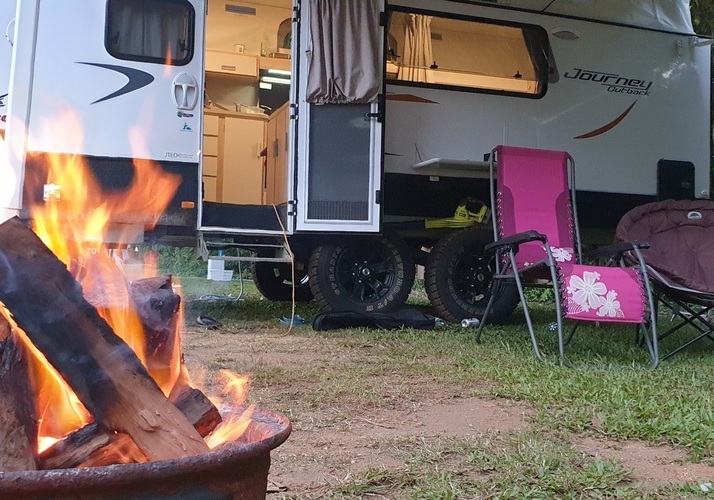
A real campfire is what separates a regular winter trip from one you'll remember.
The short version:
Bring hardwood (ironbark, redgum, or box from Bunnings — not servo wood)
Bring more kindling than you think you need
A long-neck lighter is the best six bucks you'll ever spend
Build for breathing room, not density — a dense pile suffocates the flame
If your wood is damp, dry the next pieces near the fire first
For the full playbook — including foraging laws, fire structure, wet-weather hacks, and the old-school neighbourly coal-borrow trick — read Camplify's guide on building a campfire →.
8. Hire a winter-ready rig if you're heading south — standard's fine up north
)
The biggest mistake winter hirers make is treating every winter trip the same.
Australia is big, and the kit your rig needs depends entirely on where you're going.
Where heating actually matters:
Tasmania, the Snowies, the Victorian High Country, southern Victoria and SA, southern WA, and inland NSW. Here, a diesel or gas heater stops being a nice-to-have and becomes the difference between a great trip and a sleepless one. Sub-zero nights are common; mornings start with frost.
Where heating is optional — even a nice pleasantry:
The top half of the country. Most of Queensland, the Top End, northern WA, and even the Sydney-to-Newcastle stretch in winter rarely drops below 5°C overnight. A well-insulated rig with a doona and an electric blanket is plenty. Heating becomes a "nice extra" rather than essential kit.
If you're heading south or alpine, look for:
A diesel or gas heater — runs without mains power, holds the cabin near 20°C while it's near-zero outside
Decent insulation — caravans and motorhomes are built for cold weather; older campervans often aren't
An electric blanket — comes standard in many of our RVs
A solar setup — keeps the battery topped up through shorter winter days
Owner notes on cold-weather use — if the listing specifically mentions winter trips, you're in safer hands
Heading north? Don't sweat the heater. A summer-spec rig is fine — pack a doona, an extra layer, and you're sorted.
How to stay warm camping in winter → has the full playbook on heater literacy, bed insulation, and the cold-weather power maths if you're heading somewhere it really matters. Ready to book? Find a winter RV in your area →.
9. Use the owner's local knowledge — it's the best free advice you'll get
)
This is the cheat code of the Camplify model, and it's the most underused.
Every owner who's been sharing their RV through winters has built up a folder of local knowledge they'll happily share — for free.
What to ask at handover, or in messages beforehand:
Which campsites are quietest in winter
Where the best fire-permitted bush sites are
Which roads to avoid after rain
The owner's "if I had three days, I'd go here" recommendation
Whether the heater behaves the way the listing claims
Any seasonal quirks of the specific area you're heading to
The 15-minute conversation at pickup will save you more than any guidebook ever could. Owners camp where you're camping. They know what works in July versus December, which spots fill up on long weekends, where the wind hits the campsite, and which fire pits the parks staff turn a blind eye to.
It's the difference between hiring an RV and hiring a setup.
10. Embrace slow camping — winter is for savouring, not surveying
)
Winter rewards a different pace.
Summer camping is for covering ground — the big lap, multi-stop tours, busy itineraries, ticking destinations off a list. Winter is for the opposite. Pick a spot. Park up. Stay.
Three nights minimum at any campsite is the winter sweet spot. You'll burn less fuel, save the daily setup-and-pack-down ritual, get to know the local pub, find the local walking track, learn which corner of the campsite gets the morning sun. You'll know which neighbour has a roaring fire to borrow coals from by night two.
The Camplify community sees this in the data — winter bookings skew significantly longer than summer ones. Five-night, week-long, even fortnight hires are common from June through August. The flexibility multiplier is real: if the weather turns rotten on day three, you don't have to drive somewhere new in the rain. Stay put, ride it out, head out again when the sun's back.
Winter is the season for savouring, not surveying.
That's not a limitation. It's the upgrade.
Winter camping - one of Australia's best kept secrets
Winter camping rewards the people who plan for it. A bit of forethought on the light, the weather, and the rig is the difference between "we should do that again" and "never again."
You've got the playbook. Pick the postcode, hire a rig that's right for where you're going, book mid-week, and get the fire going. Stay put for a few nights. Let the country slow you down.
The skies are sharper. The fire's better. Most of the campsite is yours. See you out there.
Browse Winter-ready RVs
400+ availableThe information in this blog is accurate and current as of the date of posting. Please be aware that information, facts, and links may become outdated over time.